China has approved a new batch of livestock and poultry breeds and commercial lines, including 5 black pig breeds, several green-shell laying hens, and a new white broiler. The newly approved genetics highlight improvements in growth, meat quality, egg production, feed efficiency, and breeding efficiency, while also reflecting continued efforts to develop distinctive domestic animal genetics.
China has approved a new batch of livestock and poultry breeds, commercial lines, and genetic resources, with several black pig breeds and green-shell laying hens among the more distinctive additions.
The Ministry of Agriculture and Rural Affairs of China announced on September 15 that the new breeds, lines, and genetic resources had passed evaluation by the National Commission on Livestock and Poultry Genetic Resources.
5 new black pig breeds
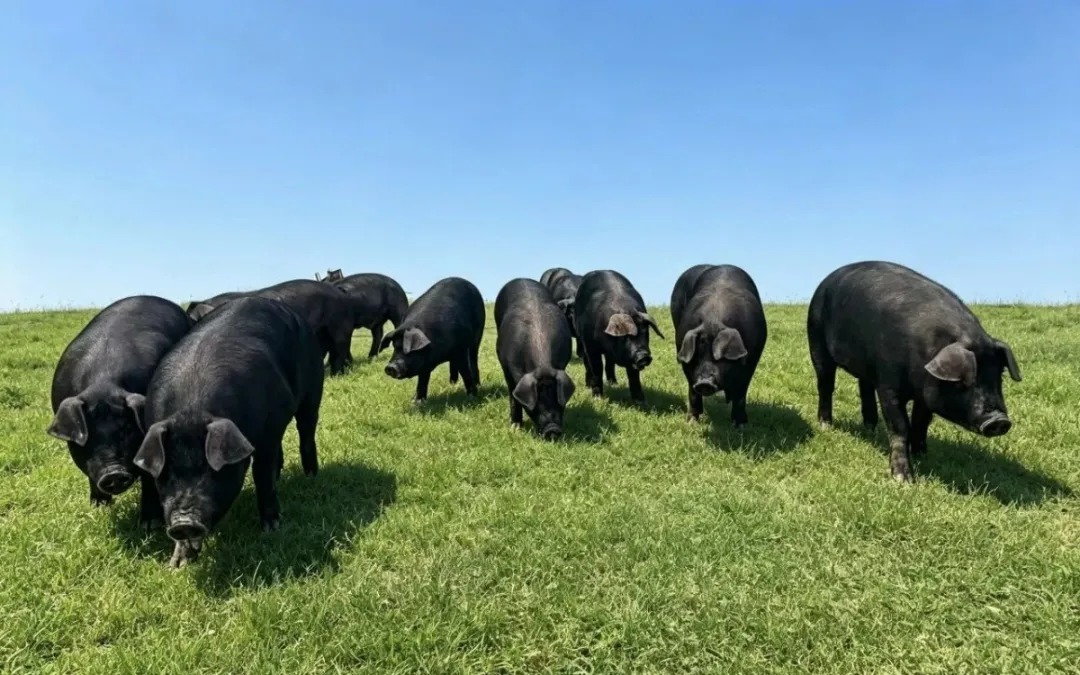
In total, 31 new livestock and poultry breeds and commercial lines received national approval. Among them were 5 pig breeds, all black pigs or black-and-white pigs.
They include the Etong Liangtouwu pig, developed by Huazhong Agricultural University together with breeders in Tongcheng county, Hubei province; the Zuili Black pig, developed by Zhejiang Qinglian; the Jinwu pig, developed by the Zhejiang Academy of Agricultural Sciences and Huateng Animal Husbandry; the Yedao Black pig, developed by the Hainan Institute of Zhejiang University, Longjian Animal Husbandry, and Huazhong Agricultural University; and the Wanyue Black pig, developed by Anhui Agricultural University and Huimingshan.
Of the 5, the Zuili Black stands out for its superior production performance. The pigs reach 100 kg at 171.39 ± 9.41 days of age, 5% earlier than Berkshire pigs. Dressing percentage is 74.68% ± 1.33%, while lean meat percentage reaches 61.30% ± 2.10%.
Intramuscular fat content is 3.41% ± 0.58%, which is 23% higher than in Berkshire pigs and 15% higher than in Duroc pigs.
Growth is considerably slower in the Yedao Black. These pigs reach 100 kg at 235.75 ± 7.39 days of age, with a feed conversion ratio (FCR) of 3.25:1. Nevertheless, both growth rate and FCR are 2-fold higher compared with its parental Tunchang pig.
Green-shell layers receive approval
Several new commercial lines of green-shell laying hens were also approved.
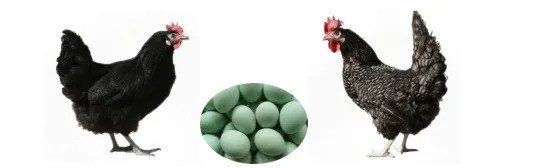
Hualü No. 1 (left) and Hualü No. 2 (right) green-shell layers.
They include Hualü No. 1 and Hualü No. 2, developed by Jiangxi Donghua Breeding Livestock and Poultry together with China Agricultural University, as well as Jingcui, developed by China Agricultural University, the Beijing General Station of Animal Husbandry, and Beijing Nongxiao Poultry.
According to AgriPost, Professor Deng Xuemei and Senior Animal Husbandry Specialist Li Junying, both from the College of Animal Science and Technology at China Agricultural University, were the principal developers of the Hualü series.
A notable feature of the breeding programme is that the same set of synthetic-line genetic resources was used to create 2 commercial lines with different characteristics. By combining the 4 new lines, sex can be distinguished at hatch in both Parent Stock (PS) and Commercial Stock.
The approach makes it possible to supply 2 types of high-producing, high-quality green-shell laying hens while keeping breeder costs to a minimum. According to the source, using 1 set of breeding resources to produce 2 commercial lines is a first in layer breeding in China and internationally, and provides a replicable model for conserving and commercially developing indigenous chicken resources.
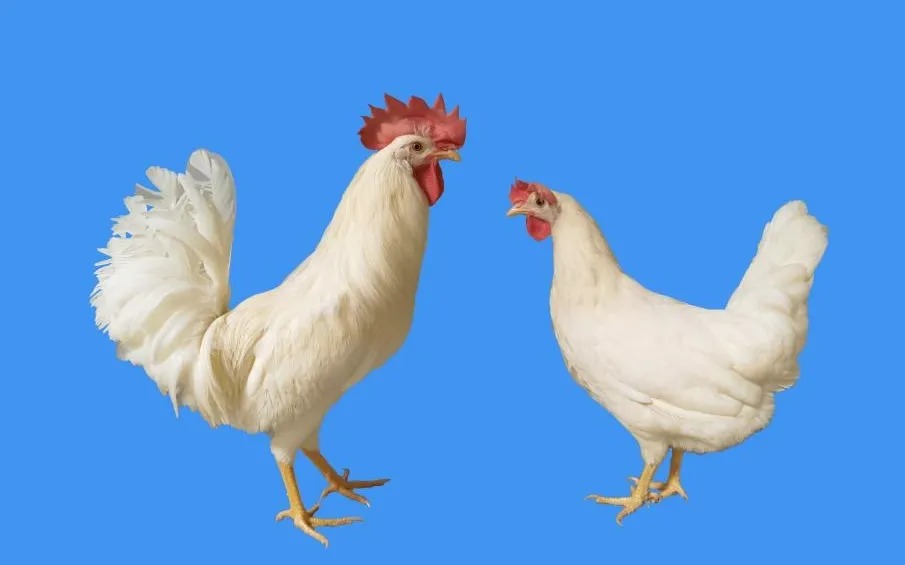
Jingcui Parent Stock males and females.
Jingcui, meanwhile, was developed under the leadership of Professor Qu Lujiang of the College of Animal Science and Technology at China Agricultural University.
At 72 weeks of age, Jingcui hens produce 301 eggs by 72 weeks of age, with an average egg weight of 55 g and a laying-period feed-to-egg ratio of 2.33:1. The source describes Jingcui as the world’s highest egg-producing green-shell layer breed.
Another white broiler enters the field
The approvals also include a new white broiler: the Wode 178 commercial line, jointly developed by Yukou Poultry and China Agricultural University.
Its arrival follows the launch of 3 domestically developed white broilers at the end of 2021: Shengze 901, Guangming No. 2, and Wode 188.
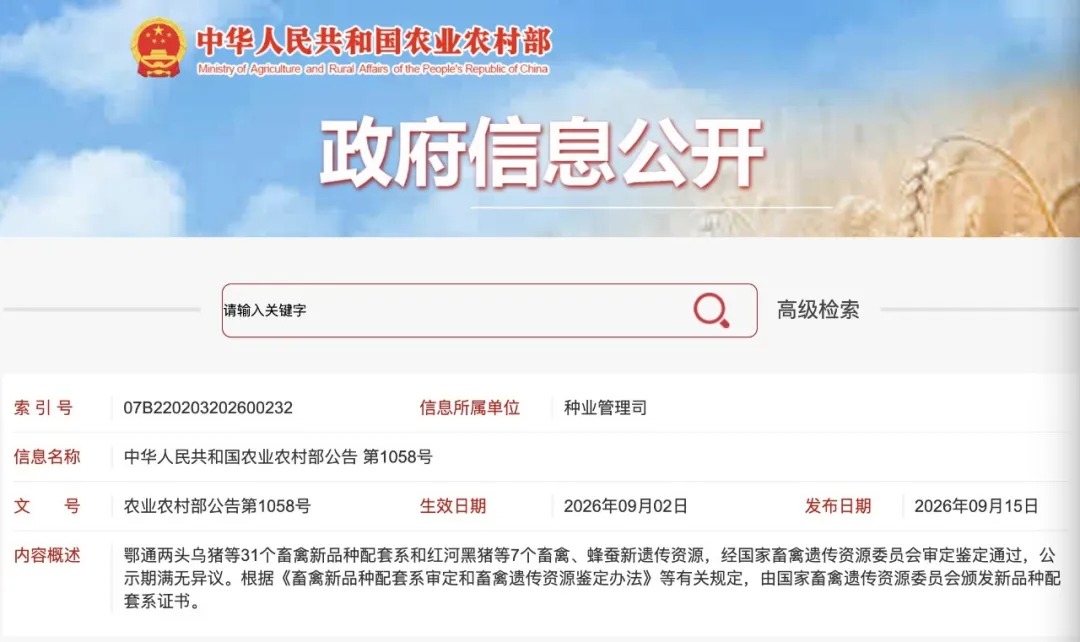
According to publicly available information cited in the source, Wode 178 is a 3-line white broiler. Its Parent Stock produces 210 ± 5.0 healthy chicks by 66 weeks of age, more than 60 chicks higher than the imported Arbor Acres breed.
At 42 days, male and female commercial broilers average more than 2.0 kg, with an FCR of 1.50:1. Compared with Arbor Acres, survival rate is 1% higher, while leg and wing proportions are 4.2% and 1.8% higher, respectively.
The breed is intended to meet China’s market demand for fast-food chicken products and is suitable for large-scale, intensive production nationwide.
Earlier this year, updated generations of Shengze 901, Guangming No. 2, and Wode 188 were also unveiled. New commercial lines including Guangming 219 and Shengze 903 successively passed on-site verification, pointing to a further expansion of China’s domestically developed white broiler portfolio.
AgriPost.CN – Your Second Brain in China’s Agri-food Industry, Empowering Global Collaborations in the Animal Protein Sector.