
China’s 3 major domestically bred white broiler lines—Shengze 901, Guangming 2, and Wode 188—are entering a new phase of genetic upgrading. Their latest versions, Shengze 903, Guangming 219, and Wode 188 3.0, focus on improving feed efficiency, growth, reproductive performance, carcass value, and adaptability. The 3 domestic breeds already account for more than 30% of China’s white broiler market, but the industry still relies heavily on imported breeding stock.
China’s 3 major domestically bred white broiler breeds are moving into their next generation. Shengze 901, Guangming 2, and Wode 188, all approved by the National Commission on Livestock and Poultry Genetic Resources at the end of 2021, have recently revealed their latest upgraded lines.
Wode 188 expands into 4 versions
The first announcement came from Beijing Wode Chenlong Biotechnology, which presented what it described as a major breakthrough in white broiler breeding at a poultry industry forum in July.
Wode 188 is not positioned as a single breed, but as an evolving breeding portfolio. The company has gradually developed 4 versions aimed at different markets.
The original Wode 188 serves as the international version, primarily targeting overseas demand for smaller birds weighing 1.5–2.0 kg. Wode 188 1.0 is positioned as the high-output version for China’s fast-food and other markets requiring smaller portioned cuts.
Wode 188 2.0 is the high-efficiency version, designed for larger portioned products sold through supermarkets and the braised-food sector. Wode 188 3.0, meanwhile, is positioned as the high-value version for markets focused on higher-value cuts. The latter 3 versions have a target market weight of 2.5–3.0 kg.
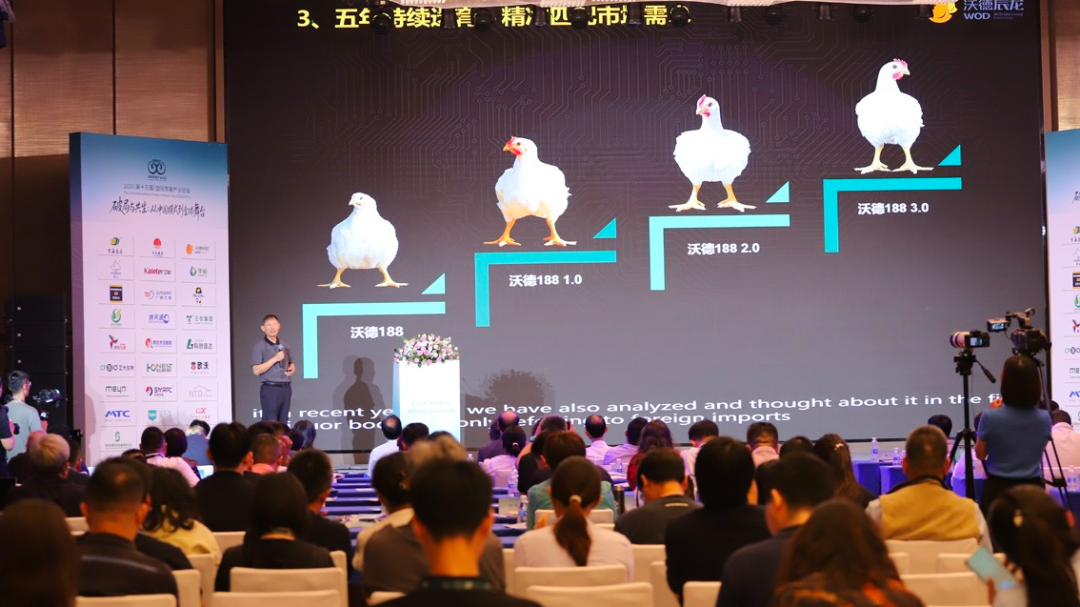
According to Wode Chenlong, Wode 188 3.0 was bred with the objective of “maximising value across the production chain”. The company says the line combines higher reproductive efficiency in Parent Stock (PS) with greater overall value in commercial stock broilers.
Peak PS egg production rate can reach 94%, with birds kept for up to 72 weeks. Production reaches 250 eggs per hen housed and 214 chicks per hen housed. Continuing reach 2.5 kg at 42 days, with a feed conversion ratio (FCR) of 1.47:1 and survival of up to 98.5%.
The latest version also comes with what the company calls its “4 bigger, 1 smaller” advantage. At the same meat output per unit area, wings are 8% larger, feet 20% larger, gizzards 20% larger, and legs 10% larger, while breast size is 15% smaller.
Wode Chenlong says this cut distribution helps maximise value throughout the chain, generating CNY 1–2 (USD 0.14–0.28) more profit per bird than commonly used breeds on the market.
Guangming 219 undergoes on-site verification
The next development came on August 11, when Shandong Guangming Biotech held an on-site verification meeting in Jinan, Shandong, for its new Guangming 219 white broiler line.

The company has not released performance data for the new bird. It described Guangming 219 as another important step in the continued development of domestically bred white broilers following Guangming 2.
Built on mature genomic selection technology, a standardised breeding system, and breeding materials accumulated over many years, Guangming 219 has been further optimised for growth efficiency, feed conversion, reproductive performance, and environmental adaptability.
According to Guangming Biotech, the new line is better suited to China’s diverse production models while also offering overseas markets a differentiated Chinese breeding-stock option.
Sunner moves from Shengze 901 to 903
Just 1 day later, from August 12–14, an expert group from the National Commission on Livestock and Poultry Genetic Resources visited Guangze, Fujian, to conduct on-site verification of Sunner’s Shengze 903 white broiler line.
Sunner said Shengze 903 is a new-generation line developed through continued selection and improvement following the commercial application of Shengze 901. The company had already started using the new line at scale internally before the line passed the on-site verification.
While retaining the reproductive performance of the existing breeder stock, Shengze 903 has improved FCR, growth rate, and survival. Sunner says the broiler’s overall performance has reached an internationally advanced level and that it performs well under Chinese production conditions.
Based on these performance improvements, Sunner is looking to use breed upgrades to raise returns across the entire production chain while also offering overseas markets a differentiated source of Chinese genetics.

The company also reported that, by the end of June 2026, Shengze 901 PS had reached 16 provinces, autonomous regions, and municipalities across China. Cumulative distribution stood at 52.7 million sets, giving the breed a 20% share of the domestic market.
Domestic genetics gain ground, but imports still dominate
The 2025 annual report of China’s National Broiler Industry Technology System showed that Shengze 901, Guangming 2, and Wode 188 together had already captured more than 30% of the market by 2025.
However, the report also pointed to the remaining vulnerability of the sector. Nearly 70% of China’s white broiler breeding stock still depends on foreign sources, it said, meaning domestic supply cannot yet fully safeguard stable industry operations if imports are disrupted.
According to the report, the adoption of domestic breeds remains in the early stages of expansion. The sector is now in a critical window for both technological iteration and the competition for market share, requiring long-term support from policy measures and industrial capital with strategic patience.
AgriPost.CN – Your Second Brain in China’s Agri-food Industry, Empowering Global Collaborations in the Animal Protein Sector.