China’s CCER market has added its first livestock methodology, allowing eligible large-scale pig farms with on-site anaerobic digestion and biogas use to earn carbon credits. Participation requires at least 500 head per year plus instrument-based monitoring and third-party verification, but biogas investments may take years to pay back.
China’s national voluntary greenhouse gas reduction scheme, the China Certified Emission Reduction (CCER) market, has taken a first step into livestock. The Ministry of Ecology and Environment, together with the Ministry of Agriculture and Rural Affairs, has released the Greenhouse Gas Voluntary Emission Reduction Project Methodology: Large-scale Pig Farm Manure Biogas Recovery and Utilisation Project (CCER15-001-V01) — the sixth methodology issued since the CCER market restart in January 2024, and the first aimed at animal production.
In practice, the methodology creates a scientific bridge between a pig farm’s voluntary emissions reductions and the carbon market. For qualifying farms, potential carbon income may offset part of the investment required for a “green transition” — and could speed up low-carbon upgrades, especially at large farms and integrated groups.
Agriculture’s role is far from marginal. According to China’s national greenhouse gas inventory report, emissions from agricultural activities in 2021 totalled 931 million tonnes of CO₂ equivalent (CO₂e), accounting for 7.16% of the country’s total greenhouse gas emissions. Livestock emissions (enteric fermentation plus manure management) made up over 50% of agriculture’s total.
Against that backdrop, the appeal is obvious: many on-farm measures — energy switching, gut health and management improvements, and manure resource utilisation — reduce emissions, but often require sizeable upfront spending. In a weak market, those investments can be hard to justify without a clearer incentive mechanism. The new CCER methodology changes the conversation by turning a slice of manure-related mitigation into a tradable asset.
Who can participate — and who can’t
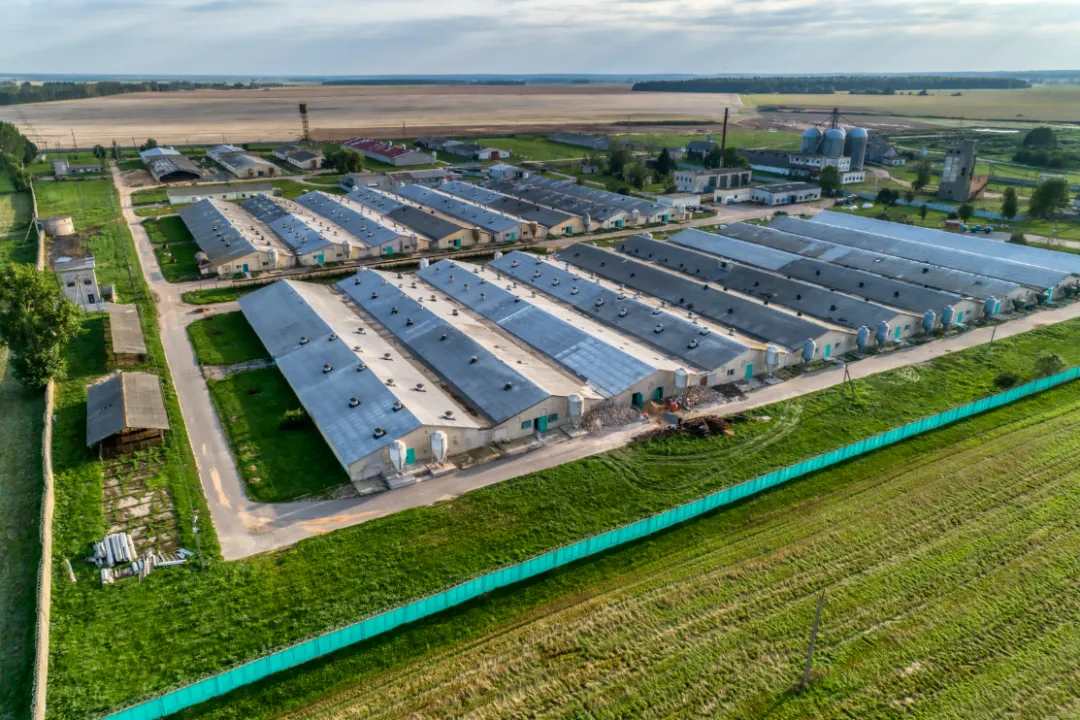
The eligibility threshold is straightforward, but strict. To apply under this methodology, a farm must meet both requirements:
- Scale: annual marketed hogs of at leat 500 head; and On-site biogas project: a biogas system built within the farm site, including an anaerobic reactor and biogas recovery and utilisation, meeting relevant national construction standards (such as having a flare system installed).
- Projects are filed under a legal entity. That can be a single independent farm, or a bundled application combining multiple eligible pig farms within the same province.
- Beyond hardware, the methodology also raises the bar on data discipline. The project owner must install and calibrate required meters and instruments, comply with parameter collection and management rules, and connect systems for online data monitoring.
Eight parameters that must be monitored
For farms that want to develop a CCER project in the future, the methodology requires monitoring and recordkeeping for eight parameters:
- Pig inventory (live headcount on farm)
- Biogas production volume
- Average methane volume concentration in biogas
- Volume of biogas combusted by the flare
- Biogas output volume
- Biomethane output volume
- Electricity exported to outside users
- Electricity drawn from the grid
Pig inventory must be recorded daily and calculated monthly. The other seven parameters must be captured via automated instrument monitoring.
One boundary is equally important: the methodology only covers the manure-to-biogas recovery and utilisation portion of a large-scale pig farm project. Regular farm operations, as well as the farmland recycling and utilisation of digestate, are not included within the project boundary.
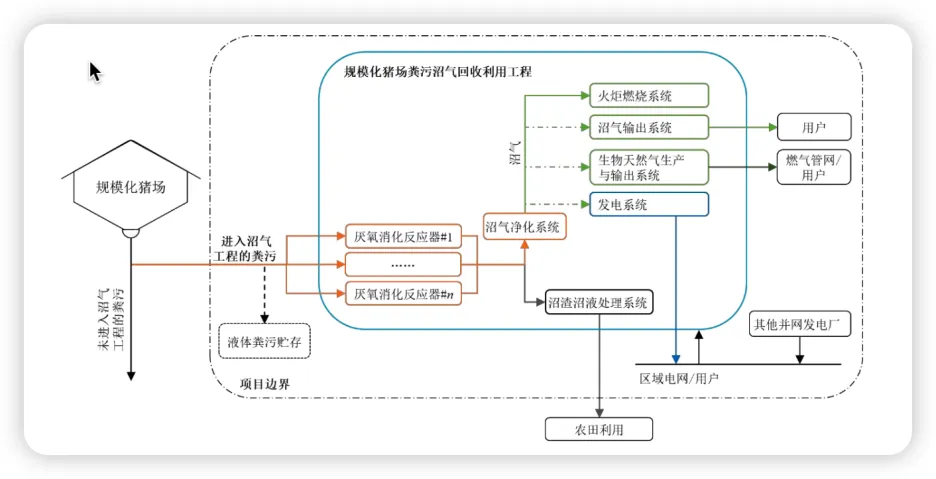
Project boundary diagram (Source: CCER-15-001-V01)
From registration to trading: a five-step pathway
Farms that qualify and want to proceed can either set up an internal CCER project team or work with a third-party developer. Either way, the work starts with building a ledger system and monitoring framework that matches the methodology.
A new CCER project generally follows five steps:
1) Project initiation and account opening
Because biogas systems require significant capital, farms — especially those without an existing biogas project — are advised to complete project initiation and an investment return analysis, rather than investing blindly.
To open an account, applicants must log into the national registry at https://www.ccer.com.cn/ and submit an account-opening application. Once approved, the entity completes account opening and pays the required fees. For entities that are not national or local key emitting units, the stated fees are CNY 2,000 (USD 278.55) for account opening and CNY 1,000 (USD 139.28) as an annual fee.
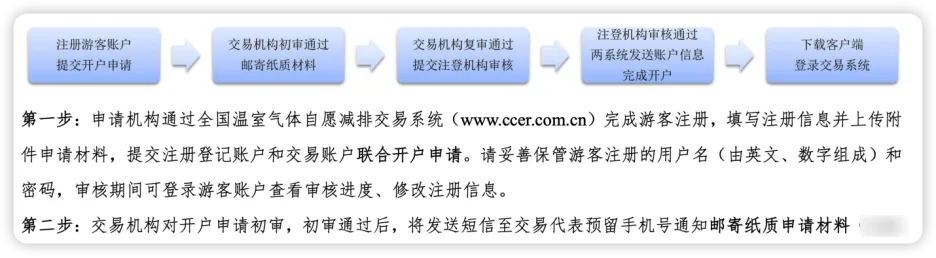
CCER project account opening process (Source: https://www.ccer.com.cn/)
2) Project design and validation
The applicant determines the baseline, monitoring plan, and emissions reduction calculation sheets per the methodology, then uploads the Project Design Document (PDD) to the system. After the public notice period ends, a professional body — a CCER validation and verification institution filed with the national accreditation authority — conducts an on-site survey.
The site visit confirms the animals are pigs and that the biogas project is located within the farm site. After confirming the implementation and monitoring plan align with the methodology, and cross-checking the emissions reductions, the institution issues a validation report.
The applicant then submits the PDD, the validation report, and related materials to the registry. After review by the registration body (the National Center for Climate Change Strategy and International Cooperation, NCSC), the project is registered and receives a project number.
3) Implementation and monitoring
The project runs according to the PDD, with ledger management and regular instrument calibration. Monitoring reports are prepared by monitoring period.
Applicants must ensure the process is verifiable throughout the crediting period. If data gaps occur, explanations must be supplemented and uploaded in time. Otherwise, emissions reduction deviations caused by missing data or inadequate monitoring will not be credited.
All records — including monitoring ledgers — must be retained for at least 10 years after the final period’s emissions reductions are registered.
4) Verification
After each monitoring period (typically one year), the same professional institution conducts on-site verification of the monitoring report and the emissions reductions, issuing a verification report. Verified annual reductions must not exceed 110% of the estimated annual reductions submitted at registration.
5) Issuance and trading
Once verification is completed, the applicant uploads the verification report to the registry for review. After approval, CCERs are issued (unit: tonnes CO₂e). After issuance, the entity is automatically linked to its account in the national emissions trading system and can use credits immediately for compliance offsetting (≤ 5%) or for over-the-counter trading.
The full application and development cycle for a new CCER project is estimated at 4–6 months. The crediting period starts from the time emissions reductions are generated as registered by the project owner; it must fall within the project’s lifetime and cannot exceed 10 years. To continue earning CCERs, applications must be made annually.
The economics: meaningful — but not a quick payback
Industry estimates cited alongside the methodology suggest that a finishing farm marketing 10,000 head per year could, if successfully registered, develop about 3,200 t of CCERs annually. Using a rough 2025 CCER trading price of CNY 50.00–80.00/t (USD 6.96–11.14/t), that implies annual carbon income of about CNY 160,000–256,000 (USD 22,284.12–35,654.60).
The same estimate adds a reality check: at least 8 years may be needed to balance the investment in the biogas project.
A bigger signal: agriculture is no longer “light” in carbon markets
CCER is a market mechanism designed to reduce greenhouse gas emissions, and it carries strategic weight in China’s “dual carbon” agenda. For livestock, the new methodology functions as a first “ticket” into carbon markets — and it challenges the old pattern where sustainability work tilted toward heavy industry and away from agriculture.

One final note: the pig-farm biogas methodology applies only to large-scale pig farms with on-site biogas projects. A second methodology released at the same time — Centralised Agricultural Waste Treatment Project (CCER-15-002-V01) — has broader application scenarios. It can involve various types of farms (not limited to large-scale pig farms) that have cooperation agreements with a centralised agricultural waste treatment project. In that case, however, the applicant must be the waste treatment project operator, not the farm — and partners must coordinate emissions reduction ownership before applying.
AgriPost.CN – Your Second Brain in China’s Agri-food Industry, Empowering Global Collaborations in the Animal Protein Sector.